CARPREG II: pregnancy risk reference
The CARPREG II study and its reported pregnancy cardiac-event risk categories.
Predictors and points
The CARPREG II index adds the points for each applicable predictor. Use the study’s definitions when assessing a patient.
| Predictor | Points |
|---|---|
| Prior cardiac events or arrhythmias | 3 |
| Baseline NYHA III–IV or cyanosis | 3 |
| Mechanical valve | 3 |
| Ventricular dysfunction | 2 |
| High-risk left-sided valve disease or left ventricular outflow tract obstruction | 2 |
| Pulmonary hypertension | 2 |
| Coronary artery disease | 2 |
| High-risk aortopathy | 2 |
| No prior cardiac intervention | 1 |
| Late pregnancy assessment | 1 |
Reported risk categories
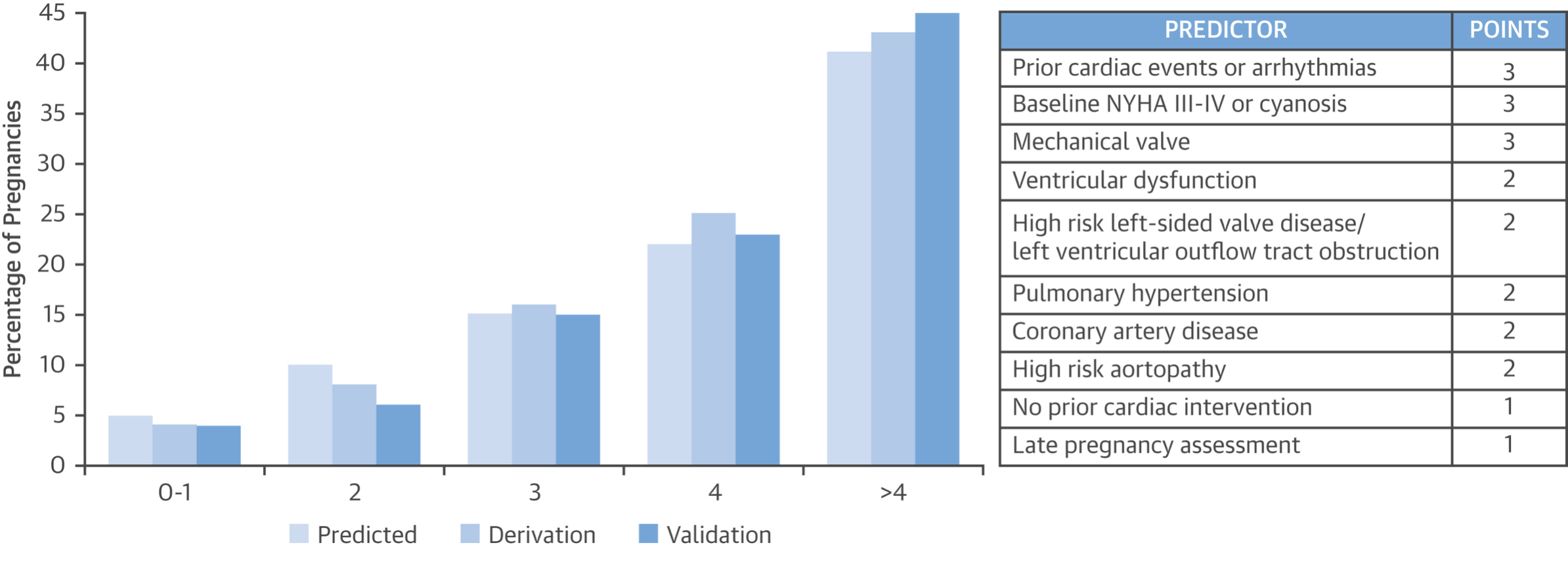
Silversides CK et al., J Am Coll Cardiol 2018;71(21):2419–30, reported five categories based on the total point score. The study compared predicted events with events in derivation and validation cohorts.
| Total point score | Reported risk |
|---|---|
| 0–1 points | 5% |
| 2 points | 10% |
| 3 points | 15% |
| 4 points | 22% |
| More than 4 points | 41% |
Study comparison: predicted and observed events
The chart compares predicted cardiac-event risk with observed events in the derivation and validation cohorts across five point-score categories. The table above gives the predicted percentages.

Primary cardiac outcomes
The study defined primary outcomes as maternal cardiac death, cardiac arrest, sustained arrhythmia requiring treatment, left-sided heart failure with pulmonary oedema, right-sided heart failure, stroke or transient ischaemic attack, cardiac thromboembolism, myocardial infarction and vascular dissection.
Wider assessment
Assessment includes:
History: cardiac events before pregnancy, baseline NYHA III–IV and no previous cardiac intervention.
Examination: cyanosis, defined as resting oxygen saturation below 90%.
Specific lesions: mechanical valves, coronary artery disease and high-risk aortopathy.
Imaging: systemic ventricular dysfunction, high-risk left-sided valve lesions or LV outflow obstruction, and pulmonary hypertension.
Care delivery: a late first antenatal visit.
Other variables to consider include:
Rare or understudied cardiac conditions.
Maternal comorbidities, including advanced maternal age, hypertension and obesity.
Medicines, including anticoagulants.
Other test results, including cardiopulmonary exercise testing and MRI.
Fertility therapy.
Adherence to treatment.
Access to care and the quality of that care.